Working in practice
Practice theory provides a powerful lens for understanding how strategy and delivery interact in real-world transformation. It helps us see how structures and agency shape outcomes, and why grounding strategy in practice is essential for meaningful change.
Interactive strategy is grounded in practice theory. It's not new, it just hasn't been applied to digital transformation.
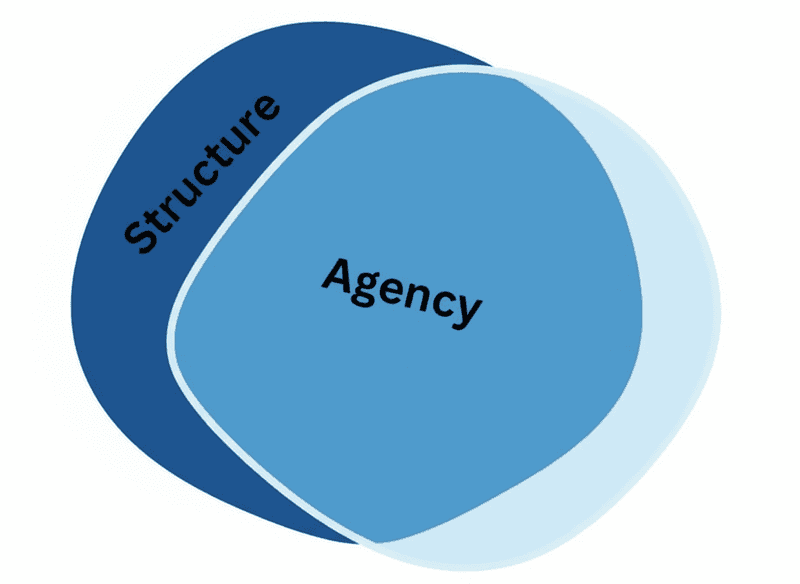
This concept isn't new-it's rooted in decades of social theory. However, it hasn't been effectively applied to digital transformation programs.
In practice theory a central debate revolves around how we rationalise the necessarily intertwined nature of agency and structure. Giddens rationalises that both structure and agency should be taken into account at the same time, informing and being informed by the other.
How does this apply to strategy and delivery?
Take the idea of structure-macro, enduring, institutional constructs like our values, political systems, educational systems, and economy. I see similarities between 'structure' and 'strategy': both are long-term and slower-moving, setting out a course over years.
I then rationalise a similarity between 'agency' and the operational environment; this might be, in a traditional digital program, delivery teams, or in an holistic sense it may be business operations. Either way, 'agency' is understood by Bourdieu as how we perform practice - how we make deliberate action.
Interactive strategy is informed by practice theory. It is the process of ensuring that strategy and action (delivery, operations) work together, continually informing the other.
Traditional strategic documents - discovery reports, digital transformation strategies, concepts of operations, even 2PBCs - are static artefacts. As they aren't kept up to date, well… they're as good as the day they're delivered, and obsolete the next. Especially as our pace of change increases, they lose relevance increasingly quickly - and I ask, then, why is strategy still being projected out years ahead?