AI and transformation
Agentic AI is not another digital tool. Thanks to advancements in Large Language Models (LLM) and Generative AI (GenAI), we are entering a paradigm shift in the way humans interact with and create value through technology. What an exciting time to be part of digital transformation!
I've been experimenting with and enhancing my work using AgenticAI
This website was built using Generative AI and Agentic AI in just 8 hours.
For the first time, front-end development is accessible to me. This is the true power of AI: it enhances, accelerates, and removes barriers. Tasks that were once difficult or out of reach are now easier and more streamlined.
I wanted to see if I could build a website using only AI tools. I started with OpenAI's ChatGPT and asked, "I want to build a website, what should I do?" The response guided me through the process, helping me choose the right type of website and next steps.
I am not a coder. I am a service designer, sociologist, and communicator by trade. As a UX designer, I design wireframes in tools like XD and Figma, but I always relied on developers to bring my ideas to life. This handover often took months, and the final product rarely matched my vision.
Thanks to the no-code Copilot AgenticAI engine in Visual Studio Code, anyone can now build a website and write code. We don't need to know the code; we just need the vision (and heck, GenAI can even help us with that).
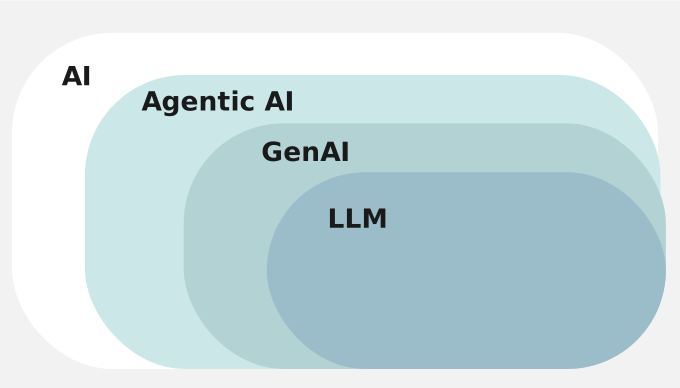 AI nesting model (adapted from Ranjan et al. 2025).
What is Agentic AI?
Agentic AI is made possible by the advent of Large Language Models (LLMs) and Generative AI (GenAI). According to Ranjan et al. (2025), Gen AI represented a shift from static, or processual (inflexible, rigid and so finnicky) automation - exemplified in Robotic Process Automation (RPA) - to a fluid and dynamic approach, enabled by LLM. Agentic AI takes it one step further: by leveraging GenAI, Agentic AI can plan, make decisions, and execute automatically without human intervention.
If you're new to AI, I find the nest diagram to the left useful - it shows how LLM informs GenAI, which informs Agentic AI, and that this all is built together to describe AI as a capability.
GenAI vs Agentic AI - what are the differences?
| GenAI | Agentic AI | |
|---|---|---|
| Core Function | Generates content (text, images, code, etc.) based on prompts | Acts autonomously to achieve goals |
| Technology | Relies on large language models (LLMs) and training data | Can use GenAI and other tools as part of its workflow |
| Autonomy | Does not have goals or autonomy | Plans, makes decisions, and executes tasks |
| Role | Acts as a tool for human creativity and productivity | Reduces need for human intervention |
| Task Handling | Requires human direction for each task | Capable of multi-step reasoning and adaptation |
Digital transformation with intelligent automation
Intelligent automation - that transforms how we leverage AI, RPA (taking a generative and a narrow view in how we use AI) - represents a strategic and paradigm shift in how enterprises and people will work and perform action. These advances are "enabling hyper-personalised services, autonomous decision-making systems and hyperautomation" (Qiu, 2025).
Key considerations
These are exciting, revolutionary technologies with immense potential; they are new and rapidly evolving. It's tempting to dive in quickly and embrace them wholeheartedly. And while I strongly advocate adoption - it is a strategic imperative for digital transformation -, there are important things to consider as you start this journey.
Put people first
Your people - internal and external stakeholders, and the users of your services - should be core to everything you do. Transformation is successful when it meets the needs of the humans it serves.
Assess Readiness
Ensure your organisation is ready to adopt intelligent automation (it might be better off starting small). AI is only as powerful as the data (and APIs) that feed it, and it's no good if people aren't ready to adopt or use these capabilities in practice.
Understand what you want to achieve
Design systems and processes to support the outcomes you want to achieve - intelligent automation is not an outcome, but a means of getting there. Don't automate for the sake of it.
Manage Change
Clearly understand how intelligent automation will change how your people work. AI is a powerful collaborator and enhancer, however it will cause displacement and change the very nature of how things are done.
Clear rules and transparency
Build systems that are fair, transparent, and make it clear who is responsible for decisions. Use tools like explainable AI and clear business rules to help everyone understand how and why decisions are made.
Build and maintain trust
We must be cognisant of how Australians trust and understand how and why their data is used, and is securely stored. While Australians are more trusting than the OECD global average (OECD, 2025), we must continually invest in systems to maintain data security and public trust. Complacency kills.